
By: David Lundgren, Senior Wealth Advisor
In many recent client conversations, clients have a similar observation “The news sounds terrible… so why does the market look fine?”
It’s understandable. We’re surrounded by headline noise, talk of a “K-shaped economy,” rising costs, fears of an AI bubble, global uncertainty, and whatever else is dominating the feed that day. At the same time, the actual market data has been surprisingly resilient.
When those two things don’t match, it creates a natural sense of unease. That’s exactly why moments like this matter: they’re a reminder to look beyond the headline and pay attention to what’s actually happening underneath.
Before we go any further, I think it’s important to set expectations clearly. No chart or historical pattern can predict the future, and past performance never guarantees future results. What long-term market behavior can offer is context. It helps you understand what’s typical, what’s unusual, and how to make thoughtful decisions even when the noise feels overwhelming.
Markets Need Breaks, and It Doesn’t Mean Something’s Wrong
One thing I often explain to clients is that markets behave a lot like people. If you’ve been running nonstop, eventually you need to catch your breath. A pause isn’t a sign of weakness. Instead, it’s a sign of adjusting for efficiency. Markets work the same way.
As long-term investors, we have to be comfortable with the fact that volatility happens. It’s normal and it doesn’t automatically signal that something is wrong. It’s just how markets function. A chart I refer to often helps illustrate this:
Annual Returns and Intra-Year Declines (1980–2025)
Source: J.P. Morgan Asset Management
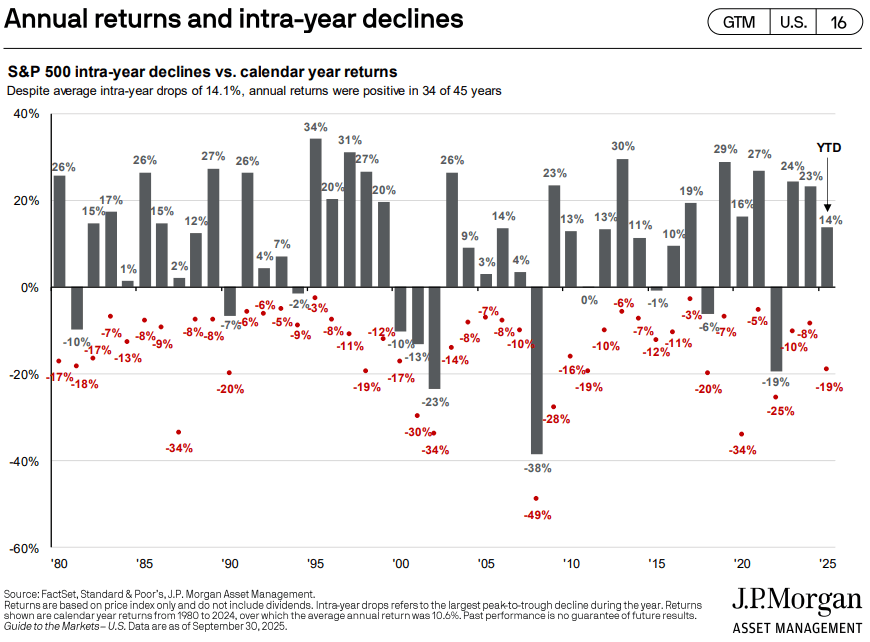
This chart shows two things at once: how much the S&P 500 fell at its worst point during each year, and how it ended in December. What stands out is that even in years with uncomfortable drops along the way, most still finished positively.
Why Timing the Market Doesn’t Work
One of the most tempting responses to headlines is to step aside for a bit. Sell your shares, wait for things to “calm down,” and plan to get back in later. I understand the instinct, but the data tells a different story.
Here’s a chart that captures the cost of trying to outmaneuver short-term market moves:
What Missing the Best Days Does to Your Returns
Source: YCharts
This chart is one of the clearest illustrations of why discipline matters:
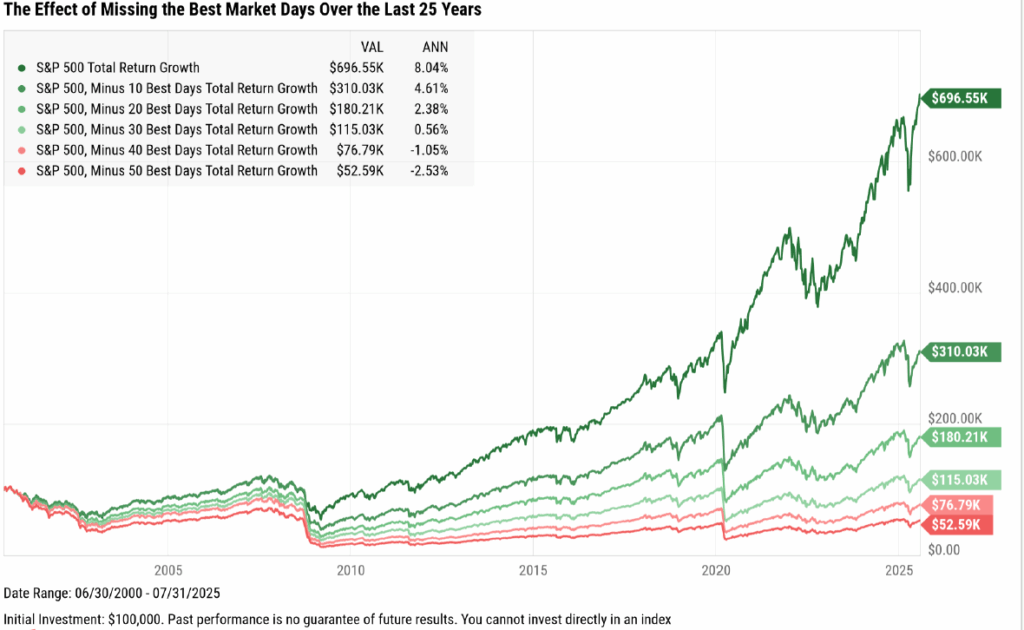
- Staying invested lets you participate in the full long-term growth of the market.
- Missing even a handful of the best days dramatically reduces long-term returns.
- Historically, those “best days” often happen immediately after “worst days,” meaning the recover often begins before it feels like things have improved.
This is why I emphasize a consistent, disciplined approach. Trying to jump in and out based on headlines is one of the quickest ways to unintentionally fall behind.
What Actually Deserves Your Attention
When the narrative gets overwhelming or the news feels loud, I try to bring conversations back to the things that matter more than whatever is circulating on social media or the evening news.
1. The underlying data.
Headlines are designed to provoke a reaction. Fundamentals such as earnings, employment, production, and consumer behavior usually tell a more accurate story.
2. Your short-term cash needs.
If you’ll need money in the next 6–12 months, we’ve likely accounted for it. We try to protect those dollars from volatility so you’re not forced to react to market swings.
3. Your long-term goals.
Your plan is built for your life, not the news cycle. The timeline that matters most is yours, not the market’s.
4. Risk that fits your actual life.
Good planning helps align your investment approach with your reality: your career, your family, your stress tolerance, your future needs. When those things are aligned, headlines lose their power.
Finding Clarity in the Data
I tend to bring charts into conversations because they help cut through the noise. Headlines are built to grab attention, but data gives you a clearer view of what’s actually happening. When you can see decades of market behavior laid out visually, putting current events in perspective becomes much easier.
Charts aren’t about predicting what’s next, they’re reference points. They help distinguish what’s typical from what’s unusual, and they ground financial decisions in facts rather than feelings. In most cases, that clarity does far more good than anything you’ll find in a fast-moving news cycle.
Zooming Out When the Noise Creeps In
No matter what’s happening beyond your control, come back to the core of your financial life: your plan, your goals, and the timeline that actually matters. Markets move, headlines flare, and narratives shift, but your long-term objectives tend to stay far more consistent. My job is to help keep those priorities front and center and ensure the decisions we make reflect the life you’re building, not the noise surrounding it.
Advisory services offered through Meridian Wealth Management, LLC, a Registered Investment Advisor. Seek tax, legal, insurance, and investment advice from a licensed professional relative to your situation. The information and opinions voiced in this material are strictly for general information only and are not intended to provide any security recommendations, specific advice, or recommendations. Any views or opinions presented in this material are solely those of the Strategic Wealth Group and do not necessarily represent those of Meridian Wealth Management, LLC. No one connected with Meridian Wealth Management, LLC, can ensure the tax consequences of any transaction. All investing involves risk, including loss of principal. Past performance does not guarantee future results. No strategy ensures success or protects against loss. Further, readers should be aware that websites or sources used in this work may have changed or disappeared between when this work was written and when it was read.